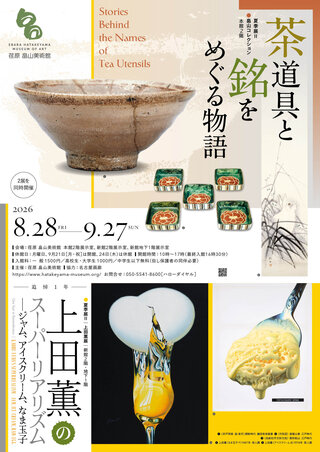
Stories Behind the Names of Tea Utensils / One Year in Remembrance KAORU UEDA’S SURPERREALISM―JAM, ICE-CREAM, RAW EGG
We will simultaneously hold the following two exhibitions as our 2026 Summer Exhibition.
◆【Main Building 2F】 《Hatakeyama Collection》Stories Behind the Names of Tea Utensils
◇ Stories Behind the Names of Tea Utensils
This exhibition focuses on the stories behind masterpieces of tea ceremony utensils that have been cherishingly preserved and passed down through the ages. Tea masters, with deep respect and affection for each of these one-of-a-kind utensils, bestowed upon them special names known as “銘 mei.” The term “銘 mei” refers to the alternative names given to exceptional tea utensils. These names, inscribed on the utensils themselves or on their storage boxes, serve to convey the intellectual playfulness and aesthetic sensibilities of those who loved tea utensils to people living today. Here we would explore the theme of “Why was this particular inscription chosen for this piece?” and introduces the stories hidden within these tea utensils. Works traditionally considered ideal for hospitality that evokes a sense of coolness during the hot summer or early Autumn months are also displayed. We hope you would enjoy viewing the exhibition as if you had been invited to a tea ceremony unique to this season.
◆A Highlight of the Main Building 2F
≪Important Cultural Property<Portrait of TOYOTOMI Hideyoshi>(Attributed to KANŌ Sanraku(1559-1635) Inscription by KONOE Nobutada(1565-1614)≫ on special display
This work is known as one of the most representative portraits of TOYOTOMI Hideyoshi. With interest in the Warring States period on the rise thanks to the NHK Taiga drama(Historical epic series) currently airing, we invite you to take this opportunity to view this painting at our museum.
◆【Annex Building】 One Year in Remembrance KAORU UEDA’S SURPERREALISM―JAM, ICE-CREAM,RAW EGG
◇An Invitation to Abstraction and Beauty: Masaaki Yamada―Selected Works from Private Collections
From Ultimate Abstraction to Ultimate Realism: A Vivid Relay of Two Artistic Expressions
This two-part summer exhibition series presents two contrasting modes of artistic expression. Centered on the theme “From Abstraction to Realism,” the series introduces the richness and diversity of contemporary art.
Part I invites visitors to a memorial exhibition marking the first anniversary of the passing of Kaoru UEDA, a painter who represents contemporary Japan. The “Super-realism” pursued by UEDA is a hyper-realistic style that projects photographs onto canvas to vividly capture fleeting moments—such as a raw egg falling or ice cream scooped with a spoon—that the naked eye cannot fully perceive. The vibrant colors that seem to overflow from the canvas evoke a sense of wonder and elation in viewers, making them feel that the works are “more beautiful than the real thing.”
This exhibition features over 60 works, ranging from his early pieces and masterpieces to his later years, when he broke away from realism to pioneer new artistic horizons. Additionally, we are pleased to present, for the first time, the heartwarming quilts created by his wife, Yoko, who supported him throughout his life.
We hope you would enjoy the Annex—for which Hiroshi SUGIMOTO created the basic design—a space where masterful Artistic+Technical Capabilities and the journey of life resonate together. Please come visit the tranquil forest of Shirokanedai to experience a “一期一会 once-in-a-lifetime moment” that echoes the spirit of the tea ceremony in the main building.
【Kaoru UEDA 1928-2025】
He was an Artist of Super-realism (also known as photorealism or hyperrealism—is an art movement where artists meticulously reproduce a photograph using painting, drawing, or sculpture). Born in Yoyogi, Tokyo, in 1928. Inspired by his encounter with art historian Sōichi TOMINAGA, he aspired to become a painter and enrolled in the Oil Painting program at the Tokyo University of the Arts. He graduated from the university in 1954. In 1958, he held his first solo exhibition at the MINAMI Gallery. Meanwhile, in 1956, he won the International Grand Prize at the MGM International Poster Competition and became active as a graphic designer. He subsequently devoted himself to work in the field of design for about 10 years. Around 1968, he resumed painting. Using a technique that involved projecting photographs onto canvas, he created works such as his representative piece <RAW EGG>, which attracted significant attention. His innovative realistic style was highly acclaimed for its resonance with the Superrealism movement of the same period. He served as a professor at Ibaraki University and Yamano College of Beauty and Art. He passed away on September 26, 2025, at the age of 96.